




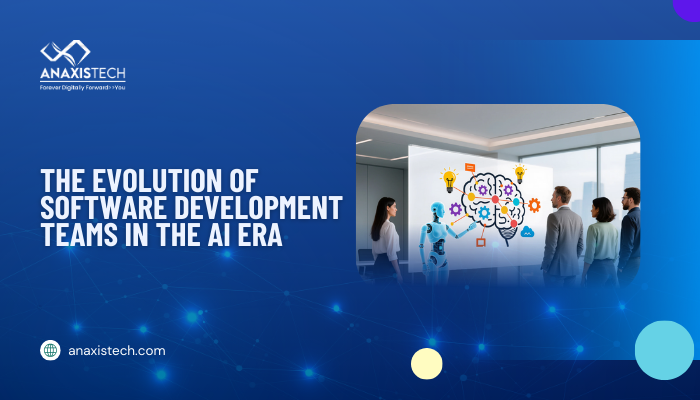
Software development teams in the AI era are undergoing a major transformation as artificial intelligence becomes a core part of the development lifecycle. From automated coding to AI-driven testing and deployment, teams are no longer working the way they used to.
In this blog, we explore how the AI era is redefining software teams, the new roles emerging, and what the future of software innovation looks like.
1. The Shift From Traditional Development to AI-Driven Models
Historically, software development followed predictable, linear processes—heavy on manual coding, documentation, and lengthy release cycles. But AI has disrupted this model dramatically.
Modern teams now leverage tools that automate repetitive tasks, such as:
- Code generation and error detection
- Testing and QA
- Deployment and infrastructure management
- Documentation and requirements analysis
With AI taking over the repetitive work, developers spend more time on creative problem-solving, strategic thinking, and building better user experiences.
This shift has shortened release cycles, improved code quality, and accelerated innovation across industries.
2. The Rise of AI Developers: A New Breed of Talent
The term AI Developer no longer refers only to professionals building AI systems. In the modern context, AI developers are professionals who:
- Build software with AI tools
- Integrate AI features into applications
- Understand how to train, fine-tune, and deploy AI models
- Collaborate with traditional developers, data engineers, and product owners
- Use AI-augmented workflows to increase output
These developers leverage AI copilots, intelligent IDEs, and automation frameworks, transforming every stage of development—from coding to deployment.
Their presence makes teams faster, smarter, and more capable of handling complex, data-driven solutions.
3. Agile Teams Reinvented: The New AI-Assisted Collaboration Model
Agile methodologies have always emphasized flexibility, iteration, and continuous improvement. With AI in the picture, agile becomes even more powerful.
How AI enhances agile teams:
- Backlog grooming becomes more accurate through AI-powered priority predictions.
- Sprint planning becomes data-driven, with AI estimating effort and complexity.
- Daily standups benefit from real-time automated progress insights.
- Retrospectives improve through AI analysis of sprint performance trends.
AI does not replace agile — it enhances it.
Teams now operate in a hybrid format where humans focus on creativity and decision-making, while AI handles analysis, automation, and forecasting.
4. New Roles Emerging in the AI-Driven Development Landscape
As AI reshapes development practices, several new job roles are emerging:
AI Product Owner
Manages AI-driven features, ensures responsible use, and aligns product development with business goals.
AI Quality Analyst
Validates model performance, tests AI-driven features, and ensures accuracy, fairness, and compliance.
ML Ops Engineer
Bridges the gap between development and machine learning models, ensuring reliable deployment and monitoring.
Prompt Engineer / AI Workflow Designer
Designs high-quality prompts and workflows to maximize the output and accuracy of AI tools.
These roles reflect a future where AI is integrated into the core of product development, not treated as a separate specialization.
5. The Power of AI-Driven Software Innovation
AI is transforming not just how teams work, but what they can create.
AI-led innovation is enabling:
- Intelligent, self-learning applications
- Predictive analytics integrated into everyday tools
- Automated workflows that reduce operational load
- Smarter user interfaces
- Scalable, cloud-native architectures
Businesses adopting AI-driven development strategies gain a strong competitive advantage. They innovate faster, respond quickly to market needs, and deliver higher-quality products.
6. Challenges in Managing AI-Enabled Teams
Despite its advantages, the shift to AI-supported development introduces several challenges:
- Skill gaps requiring continuous upskilling
- Ethical concerns around model use and data
- Heavy dependence on high-quality training data
- Increased security risks from new integrations
- Cultural shifts from manual workflows to automation-driven environments
Organizations that address these challenges early will gain the most value from AI.
7. How Businesses Can Prepare for AI-Enabled Development Teams
To remain competitive, companies must begin restructuring their teams and processes now. Key steps include:
Upskill Existing Teams
Invest in training related to AI tools, machine learning principles, and AI-assisted development workflows.
Adopt AI Tools Across the Software Development Lifecycle
Implement AI copilots, automated testing platforms, and ML-powered project management tools.
Build Cross-Functional Agile Pods
Combine developers, AI engineers, data engineers, DevOps, and product strategists.
Strengthen Data Infrastructure
Ensure access to clean, well-governed, and reliable data pipelines to support AI development.
Redefine KPIs
Shift performance focus toward quality, innovation speed, and productivity rather than manual output.
These steps help companies transition into AI-first development models effectively.
8. The Future of Software Development Teams: Human and AI Collaboration
The future is not about replacing developers with AI.
It is about creating hybrid development teams where AI enhances human capabilities. These teams will become:
- Faster
- More accurate
- More creative
- More efficient
- Better equipped to innovate
AI will handle automation, data processing, and predictive tasks. Humans will lead strategy, creativity, ethical decision-making, and problem-solving.
By 2030, most development teams will operate as AI-augmented agile units, delivering innovation at a speed never seen before.
Conclusion
The evolution of software development teams in the AI era marks a major shift in how technology is built and delivered. With the rise of AI developers, automated workflows, and new agile collaboration models, businesses that embrace this change will lead the future of digital innovation.
AI does not replace software teams — it empowers them.
As organizations continue to modernize, the combined strengths of human intelligence and AI capabilities will define the next generation of software innovation.



Leave a Reply