




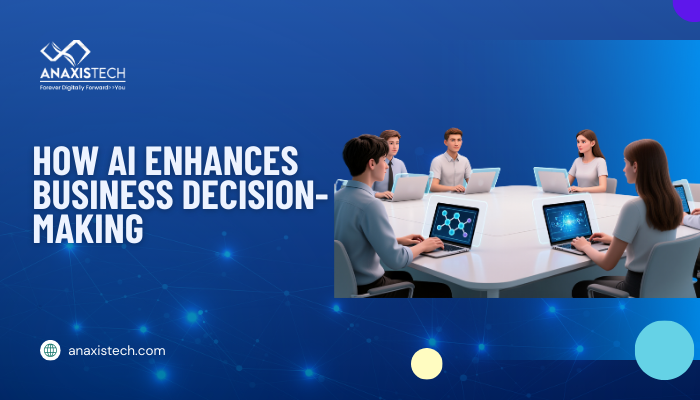
In today’s data-driven world, making the right business decisions quickly can be the difference between growth and stagnation. Organizations are no longer relying solely on intuition or historical reports. Instead, they are leveraging artificial intelligence (AI) to analyze data, predict outcomes, and guide strategic choices with precision. As a result, ai in business has become a powerful catalyst for smarter, faster, and more confident decision-making.
1. Turning Data into Actionable Insights
Businesses generate massive volumes of data every day—from customer interactions and sales metrics to market trends and operational performance. AI systems process this data at scale, identifying patterns and insights that humans might miss.
AI enables leaders to:
- Detect trends in real time
- Identify risks and opportunities early
- Understand customer behavior deeply
- Make informed decisions backed by data
This ability to convert raw data into intelligence is one of the strongest advantages of ai in business.
2. Predictive Analytics for Smarter Planning
One of AI’s most valuable contributions is predictive analytics. By analyzing historical data and current variables, AI forecasts future outcomes with impressive accuracy.
Businesses use predictive AI to:
- Forecast demand and sales
- Optimize inventory and supply chains
- Anticipate customer needs
- Plan budgets and resources effectively
With ai in business, organizations move from reactive decision-making to proactive strategy.
3. Reducing Human Bias and Error
Human decisions can be influenced by emotions, assumptions, or incomplete information. AI introduces objectivity by evaluating data consistently and without bias.
AI-driven decision support:
- Minimizes guesswork
- Improves accuracy
- Ensures consistent evaluation criteria
- Supports fair and transparent decision processes
This leads to more reliable outcomes across departments such as finance, HR, marketing, and operations.
4. Real-Time Decision Support
In fast-moving markets, delays can be costly. AI-powered systems provide real-time dashboards and alerts that help decision-makers respond instantly to changes.
Examples include:
- Dynamic pricing adjustments
- Fraud detection alerts
- Operational performance monitoring
- Customer sentiment analysis
By enabling immediate responses, ai in business helps companies stay agile and competitive.
5. Enhancing Strategic and Operational Decisions
AI supports both high-level strategy and day-to-day operations. Executives use AI insights for long-term planning, while managers rely on it for operational efficiency.
AI improves decisions related to:
- Market entry strategies
- Product development priorities
- Marketing campaign optimization
- Resource allocation
This alignment ensures that decisions across all levels of the organization are data-informed and goal-oriented.
6. Empowering Teams with Decision Intelligence
Rather than replacing human judgment, AI enhances it. AI tools act as intelligent assistants, presenting insights, scenarios, and recommendations that help teams make better choices faster.
Employees gain:
- Clear visibility into performance metrics
- Confidence in decision outcomes
- Support for complex problem-solving
This collaborative intelligence strengthens organizational effectiveness.
AI enhances business decision-making by enabling organizations to process complex data sets with greater speed and accuracy. Instead of relying on manual analysis, businesses can use AI-powered tools to generate insights that support faster and more confident decisions. This capability is especially important in competitive markets where timely actions can directly impact growth and performance. As AI enhances analytical capabilities, it allows leaders to focus more on strategy and innovation rather than data processing.
Another important advantage is how AI enhances collaboration across teams. With shared dashboards, automated reports, and intelligent recommendations, teams can align their decisions more effectively. AI enhances communication by providing clear and consistent insights that everyone can understand, reducing confusion and improving coordination between departments. This leads to more efficient workflows and better overall business outcomes.
AI enhances risk management by identifying potential issues before they become critical problems. By analyzing historical patterns and real-time data, businesses can anticipate disruptions, detect anomalies, and take preventive actions. This proactive approach helps organizations reduce losses, improve stability, and maintain operational continuity. As AI enhances risk assessment, it enables businesses to make safer and more informed decisions.
In addition, AI enhances scalability by allowing organizations to handle increasing data and operational complexity without compromising efficiency. As businesses grow, decision-making becomes more challenging due to the volume of information involved. AI enhances the ability to manage this complexity by providing structured insights and automated support. This ensures that decision quality remains consistent even as the organization expands.
Conclusion
AI is transforming how businesses think, plan, and act. By delivering real-time insights, predictive intelligence, and unbiased analysis, AI empowers organizations to make decisions with greater accuracy and confidence.
As digital transformation accelerates, ai in business will continue to play a critical role in shaping strategy, improving efficiency, and driving sustainable growth. Companies that embrace AI-driven decision-making today will lead tomorrow’s competitive landscape.




Leave a Reply