




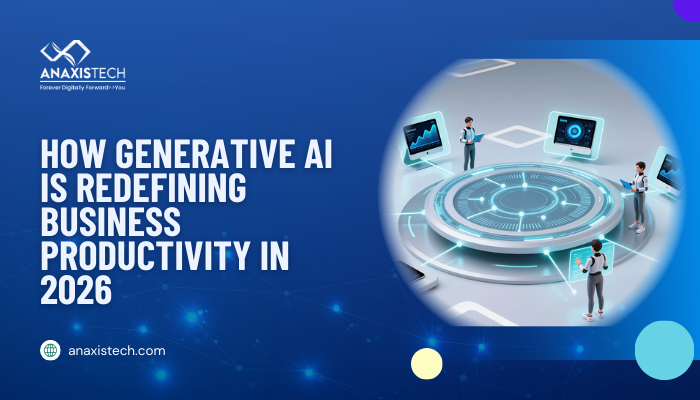
Generative AI has evolved far beyond experimental tools and automation pilots. By 2026, it has become a core driver of business productivity—reshaping how teams work, decisions are made, and value is created. From content generation and software development to customer service and strategic planning, generative AI is transforming workflows at an unprecedented scale.
Unlike traditional AI systems that focus on prediction or classification, generative AI creates new outputs—text, code, designs, insights, and solutions—enabling businesses to move faster with fewer resources.
What Makes Generative AI a Productivity Game-Changer
Generative AI systems learn from massive datasets and generate human-like responses or creative outputs in real time. This ability allows organizations to offload repetitive cognitive tasks, enabling employees to focus on higher-value work.
In 2026, generative AI is no longer just a support tool—it acts as a digital co-worker integrated into daily operations.
Key Ways Generative AI Is Improving Business Productivity
1. Accelerating Content and Communication
Businesses use generative AI to create emails, reports, presentations, marketing content, and documentation in minutes rather than hours. This reduces turnaround times while maintaining consistency and quality.
2. Boosting Software Development Efficiency
Developers rely on generative AI to write code, debug issues, generate test cases, and document APIs. This shortens development cycles and allows teams to ship products faster.
3. Enhancing Decision-Making
AI models summarize large datasets, extract insights, and suggest recommendations. Executives and managers can make informed decisions quickly without manually analyzing complex data.
4. Transforming Customer Support
AI-powered assistants handle routine queries, generate personalized responses, and support human agents with contextual information—reducing response times and increasing customer satisfaction.
5. Streamlining Knowledge Management
Generative AI acts as a centralized knowledge hub, allowing teams to retrieve internal documents, policies, and insights instantly, improving collaboration and reducing information silos.
Generative AI Across Business Functions
Operations
Automates workflow documentation, generates SOPs, and optimizes resource planning.
Marketing
Creates targeted campaigns, ad copy, landing pages, and social content based on customer behavior and trends.
Human Resources
Assists with job descriptions, interview questions, onboarding guides, and employee engagement content.
Finance
Generates financial summaries, risk assessments, budget forecasts, and compliance reports.
Productivity Benefits for Businesses
- Faster project execution
- Reduced operational costs
- Improved employee efficiency
- Higher-quality outputs
- Scalable workflows without additional headcount
By integrating generative AI into core systems, businesses in 2026 achieve more with leaner teams.
Challenges Businesses Must Address
1. Data Security and Privacy
AI systems depend on data, making security controls and governance critical.
2. Accuracy and Bias
Unchecked AI outputs can introduce errors or biased insights. Human validation remains essential.
3. Change Management
Employees must adapt to AI-assisted workflows through training and culture shifts.
Best Practices for Adopting Generative AI
- Start with high-impact, repeatable tasks
- Keep humans in the approval loop
- Integrate AI into existing tools and workflows
- Monitor outputs for quality and compliance
- Continuously train teams to work with AI
What Business Productivity Looks Like in 2026
Generative AI is no longer seen as a replacement for human talent but as an amplifier of it. Teams collaborate more effectively, innovation cycles are shorter, and organizations can respond to market changes faster than ever before.
Businesses that successfully embrace generative AI are gaining a competitive edge by unlocking productivity at scale while empowering their workforce.
As organizations continue to evolve, the focus is increasingly shifting toward building efficient and adaptive work environments that support long-term productivity. Businesses are now prioritizing smarter workflows, better collaboration, and faster execution across teams to stay competitive in a rapidly changing market. By leveraging advanced technologies in a structured way, companies can reduce inefficiencies, improve accuracy, and enhance overall performance without adding unnecessary complexity. This also enables teams to concentrate on strategic initiatives such as innovation, problem-solving, and customer engagement rather than routine operational tasks. Over time, this approach leads to stronger business outcomes, improved scalability, and a more agile organization capable of responding quickly to new opportunities and challenges.
Sustainable productivity growth also depends on how effectively organizations align their processes, people, and technology. Businesses that focus on clear goal-setting, performance tracking, and continuous improvement are better positioned to achieve consistent results. By regularly analyzing outcomes and refining strategies, companies can eliminate inefficiencies and create more streamlined operations. This approach not only improves day-to-day performance but also builds a strong foundation for long-term success. Additionally, fostering a culture of adaptability and learning ensures that teams remain prepared to adopt new tools and methods as the business environment evolves, enabling steady growth and resilience over time.
Long-term success also depends on how well organizations measure and optimize their performance over time. By setting clear benchmarks and tracking key metrics, businesses can gain better visibility into what is working and where improvements are needed. This continuous evaluation allows teams to make informed adjustments, improve efficiency, and maintain consistency across operations. Additionally, aligning performance goals with overall business objectives ensures that every effort contributes to meaningful outcomes. As companies grow, this structured approach helps maintain control, reduce risks, and create a scalable system that supports both stability and innovation.
Conclusion
In 2026, generative AI stands at the center of business productivity transformation. By automating cognitive tasks, enhancing creativity, and accelerating decision-making, it enables organizations to operate smarter, faster, and more efficiently. Companies that invest in responsible and strategic AI adoption today will define the future of work tomorrow.




Leave a Reply