




Introduction
Artificial Intelligence is rapidly evolving from simple automation tools into intelligent systems capable of reasoning, coding, decision-making, and autonomous execution. The modern AI revolution is no longer just about chatbots or content generation; it is now focused on AI Agents, autonomous software engineering, and AI-driven development ecosystems. Today, AI is helping developers create applications, automate businesses, optimize workflows, and even build new AI systems with minimal human intervention.
This transformation is changing how software is built and how businesses operate in the digital era.
What Are AI Agents?
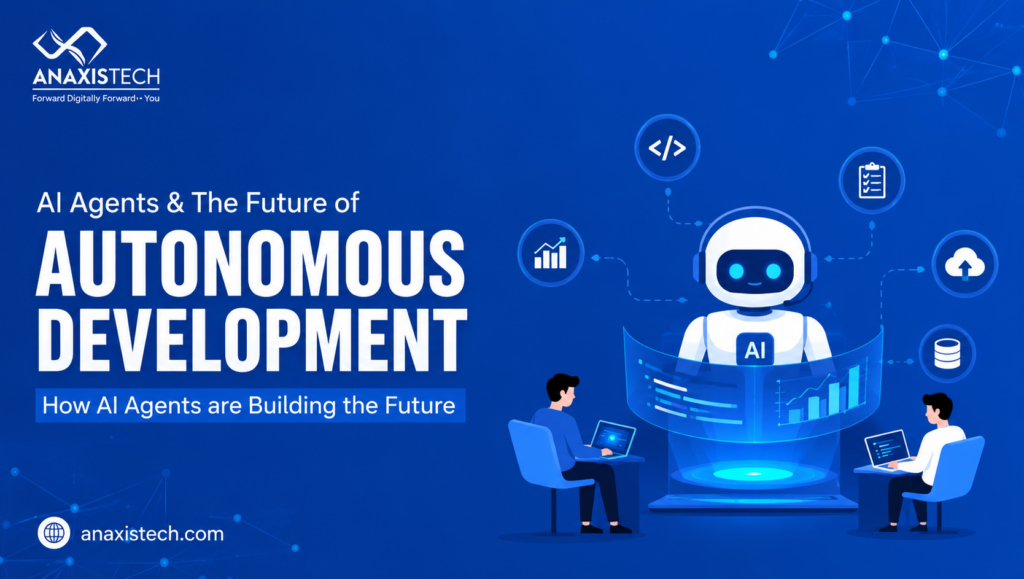
AI Agents are advanced AI systems powered by Large Language Models (LLMs) that can independently perform tasks by understanding goals, analyzing context, and executing actions step by step.
Unlike traditional AI chatbots that only respond to prompts, AI agents can:
- Plan tasks
- Make decisions
- Use APIs and tools
- Generate and debug code
- Automate workflows
- Learn from previous interactions
For example, an AI agent can receive a task such as “build an e-commerce website,” then automatically:
- Create UI designs
- Generate frontend and backend code
- Configure databases
- Deploy the application
- Monitor performance
This level of automation represents the beginning of autonomous digital workforces.
Role of AI in Modern Software Development
AI is transforming software engineering by reducing repetitive manual work and accelerating development cycles.
Modern AI development tools such as:
- Claude
- ChatGPT
- Cursor AI
- GitHub Copilot
- Devin AI
help developers:
- Generate production-ready code
- Detect and fix bugs
- Optimize architecture
- Write technical documentation
- Automate testing and deployment
Instead of spending hours writing repetitive logic, developers can focus on problem-solving, scalability, and innovation.
AI-powered coding assistants are also improving collaboration between designers, developers, and businesses by converting natural language instructions into functional software.
Claude and Advanced Reasoning Models
One of the most significant advancements in AI development is the rise of reasoning-focused models like Claude. Unlike traditional AI systems, Claude can process long contexts, analyze complex codebases, and assist in large-scale technical planning.
Claude-like models are useful for:
- Enterprise application development
- Research-based systems
- AI workflow orchestration
- Software architecture planning
These systems enable developers to handle large and complex projects more efficiently while reducing development time significantly.
Autonomous AI Engineering
A major innovation in modern AI is autonomous software engineering. AI systems are now capable of functioning similarly to junior developers by:
- Reading project requirements
- Planning technical solutions
- Writing and testing code
- Debugging errors
- Deploying applications
Projects like Devin AI demonstrate how AI can independently manage multiple stages of software development.
Although human supervision is still necessary, autonomous AI engineering is rapidly improving and may become a core part of future development teams.
Multi-Agent AI Systems
The future of AI development lies in multi-agent systems where multiple AI agents collaborate together.
For example:
- One AI agent handles research
- Another writes code
- Another performs testing
- Another manages deployment
This creates a distributed AI ecosystem capable of solving highly complex tasks efficiently.
Multi-agent systems are especially powerful for:
- Large-scale automation
- Enterprise operations
- Cloud infrastructure management
- AI product development
These systems can work continuously, making businesses faster and more scalable.
Challenges of AI-Driven Development
Despite its advantages, AI-driven development also presents challenges.
Security Risks
AI-generated code may contain vulnerabilities if not properly reviewed.
Ethical Concerns
Autonomous AI systems raise questions about accountability and responsible decision-making.
Dependency on AI
Overdependence on AI may reduce human critical thinking and creativity.
Therefore, human oversight remains essential to ensure responsible and secure AI development.
Future of AI Creating AI
The future of AI is moving toward self-improving systems capable of building smarter technologies automatically. In the coming years, AI may:
- Build full-stack applications autonomously
- Manage cloud infrastructures
- Create intelligent business systems
- Develop advanced robotics
- Generate complete SaaS platforms
Developers may soon only need to describe ideas in natural language while AI systems handle the complete execution process.
The integration of AI agents, reasoning models, and autonomous engineering will redefine the future of technology.
Conclusion
Artificial Intelligence is evolving from a support tool into an autonomous development partner. AI agents, reasoning models like Claude, and autonomous engineering systems are transforming software development, workflow automation, and business operations worldwide.
Although AI is becoming increasingly powerful, human creativity, ethics, and strategic thinking remain irreplaceable. The future will not belong to humans or AI alone, but to the collaboration between both, creating intelligent systems capable of solving real-world problems faster and more efficiently than ever before.


Leave a Reply