




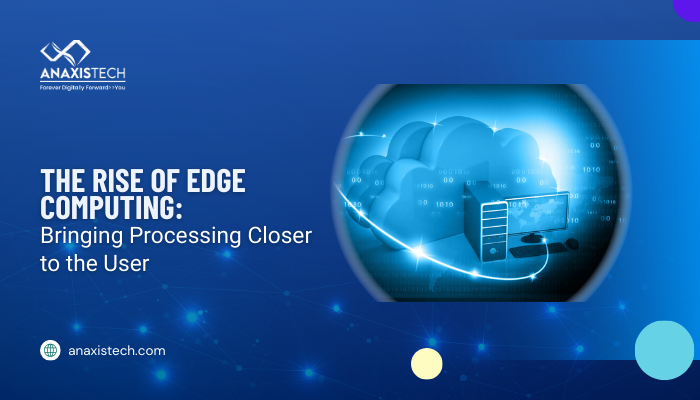
As digital demands evolve, businesses are moving beyond traditional cloud dependence and embracing a faster, more efficient model: edge computing. Instead of routing everything to distant data centers, edge computing processes data closer to where it is created. The result is improved speed, reduced latency, and smarter, more responsive systems.
For organizations building real-time applications, this shift is not just an upgrade — it’s a necessity. At AnaxisTech, we help companies adopt distributed architectures that deliver unmatched performance and reliability across industries.
What Is Edge Computing?
Edge computing is a distributed computing model where data processing happens near the data source — whether that’s a device, sensor, machine, or user location.
Rather than relying on centralized cloud servers for every task, edge devices handle part of the workload locally.
This approach significantly reduces delays and enables systems to respond instantly.
Why Edge Computing Matters Today
The future of digital systems depends on real-time performance. Applications like autonomous vehicles, smart cities, remote healthcare, and industrial automation cannot rely on high-latency cloud processing.
Here’s why edge computing is becoming essential:
1. Reduced Latency
By processing data close to the user or device, applications respond faster. This is critical for time-sensitive operations such as robotics, transportation systems, and live monitoring.
2. Improved Reliability
Even when network connectivity is unstable, edge devices can continue functioning. This ensures uninterrupted operations in remote or high-demand environments.
3. Optimized Bandwidth
Sending all data to the cloud is expensive and unnecessary. Edge computing filters and processes data locally, reducing bandwidth usage and associated costs.
4. Enhanced Security and Privacy
Sensitive data can be processed on-device without being transmitted to the cloud. This reduces exposure and strengthens overall security.
5. Better Scalability
Distributed systems allow businesses to scale quickly without overloading central servers. Workloads are shared across multiple nodes, improving overall efficiency.
Edge Computing and Business Value
Modern enterprises need applications that are intelligent, fast, and capable of handling large volumes of data. Edge computing enables:
- Smarter automation
- Real-time analytics
- Faster decision-making
- Greater operational efficiency
At AnaxisTech, we integrate edge capabilities with cloud infrastructure to help businesses build systems that adapt to user behavior and operational needs.
The Edge Computing Architecture
Effective edge solutions require a combination of cloud, local devices, and distributed systems. The architecture typically includes:
1. Edge Devices
Sensors, IoT devices, cameras, mobile devices — all capable of initial data processing.
2. Edge Gateways
Intermediate systems that aggregate and analyze data before sending selective information to the cloud.
3. Cloud Platforms
Used for long-term storage, advanced analytics, and system-wide coordination.
4. Distributed Applications
Software designed to run smoothly across multiple nodes, ensuring reliability and performance.
Real-World Applications of Edge Computing
Smart Cities
Traffic systems, surveillance, and energy grids rely on real-time analytics to operate efficiently.
Healthcare
Medical devices and monitoring tools process critical data instantly for faster diagnosis and response.
Manufacturing
Factory equipment uses edge processing to detect failures, automate machines, and reduce downtime.
Retail
Smart shelves, POS systems, and customer tracking rely on edge computing to enhance customer experience.
Logistics
Fleet management and route optimization are improved through low-latency distributed systems.
The Future of Edge Computing
By 2026 and beyond, edge computing will evolve alongside advancements like:
- AI-enabled edge devices
- 5G-powered low-latency connectivity
- Distributed cloud orchestration
- Autonomous systems that operate independently
- More secure, privacy-first architectures
The integration of AI and edge computing will create intelligent, autonomous applications capable of running with minimal cloud dependency.
How AnaxisTech Supports Edge-Based Innovation
We help businesses design and deploy high-performance distributed systems through:
- Edge computing architecture design
- Integration with cloud and hybrid environments
- Low-latency system optimization
- AI and analytics at the edge
- Real-time application development
Our solutions empower organizations to leverage the full potential of edge computing, enabling faster, smarter, and more resilient digital experiences.
Conclusion
Edge computing represents the next phase of digital evolution, bringing processing power closer to users and devices. By reducing latency, improving reliability, and enhancing security, it opens the door to real-time, intelligent applications across every sector.
At AnaxisTech, we guide businesses in adopting future-ready distributed systems that accelerate performance and deliver measurable impact.





Leave a Reply