




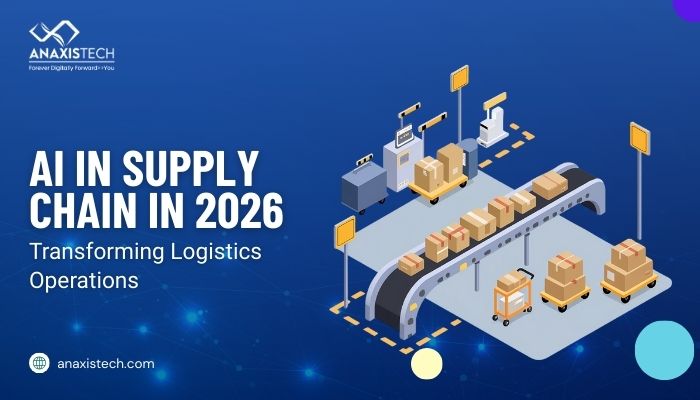
Global supply chains in 2026 are more complex, interconnected, and fragile than ever before. Rising customer expectations, geopolitical disruptions, fluctuating fuel costs, and sustainability pressures have pushed traditional logistics models to their limits. To remain resilient and competitive, enterprises are turning to ai in supply chain operations as a strategic enabler rather than a tactical upgrade.
Artificial intelligence is no longer limited to forecasting spreadsheets or isolated automation tools. It now functions as a real-time decision engine—analyzing data, predicting disruptions, and orchestrating actions across procurement, warehousing, transportation, and last-mile delivery.
Why Traditional Supply Chains Are No Longer Enough
Legacy supply chain systems rely heavily on historical data and manual planning cycles. While effective in stable environments, they struggle in today’s volatile, demand-driven markets. Delays, inventory imbalances, and cost overruns often occur because decisions are reactive rather than predictive.
This is where ai in supply chain management changes the equation. By continuously learning from live data streams—such as IoT sensors, weather data, traffic conditions, and demand signals—AI enables organizations to anticipate challenges and respond proactively.
What AI in Supply Chain Really Means in 2026
AI in supply chain refers to the use of machine learning, predictive analytics, computer vision, and autonomous decision systems to optimize end-to-end supply chain operations. Unlike rule-based automation, AI systems adapt dynamically to changing conditions without constant human intervention.
In 2026, leading enterprises deploy AI not just for efficiency, but for resilience, scalability, and customer experience. Supply chains are becoming intelligent networks capable of self-correction and continuous optimization.
Key Areas Where AI Is Transforming Logistics
Demand Forecasting and Planning
AI-driven demand forecasting models analyze historical sales, seasonal trends, promotions, market signals, and external factors like economic data or social trends. This enables far more accurate predictions than traditional forecasting methods.
By improving forecast accuracy, ai in supply chain planning reduces stockouts, excess inventory, and rushed replenishment—directly impacting profitability and service levels.
Inventory Optimization
AI continuously monitors inventory across warehouses, stores, and in-transit locations. It determines optimal reorder points, safety stock levels, and product placement based on real-time demand and lead times.
This intelligent balancing act ensures the right products are available at the right locations, minimizing carrying costs while improving order fulfillment rates.
Warehouse Automation and Operations
Modern warehouses increasingly rely on AI-powered robotics and computer vision systems. These technologies optimize picking routes, automate sorting, detect damaged goods, and improve space utilization.
With ai in supply chain warehouse operations, fulfillment centers operate faster, safer, and with fewer errors—especially during peak demand periods.
Transportation and Route Optimization
AI analyzes traffic patterns, fuel costs, weather conditions, delivery windows, and carrier performance to optimize transportation routes in real time. When disruptions occur—such as road closures or port congestion—AI systems reroute shipments automatically.
This level of intelligence reduces delivery times, lowers fuel consumption, and improves on-time delivery metrics across global logistics networks.
AI-Driven Risk Management and Resilience
One of the most strategic benefits of ai in supply chain management is proactive risk mitigation. AI models continuously scan for signals that indicate potential disruptions, such as supplier delays, geopolitical events, labor shortages, or natural disasters.
By identifying risks early, organizations can:
- Switch suppliers proactively
- Rebalance inventory across regions
- Adjust production schedules
- Communicate delays transparently to customers
This predictive resilience is critical in a world where supply chain shocks are no longer rare exceptions.
Sustainability and Cost Efficiency Through AI
Sustainability has become a board-level priority, and ai in supply chain plays a key role in achieving environmental goals. AI helps organizations reduce emissions by optimizing transportation routes, consolidating shipments, and minimizing waste.
At the same time, these optimizations lower operational costs—creating a direct link between sustainability initiatives and financial performance.
How to Implement AI in Supply Chain Successfully
To unlock the full value of ai in supply chain, organizations should take a phased and strategic approach:
Step 1: Build a Unified Data Foundation
AI depends on high-quality, integrated data. Consolidate data from ERP systems, logistics platforms, IoT devices, and external sources into a centralized data layer.
Step 2: Start with High-Impact Use Cases
Begin with areas like demand forecasting or transportation optimization where AI can deliver quick, measurable results.
Step 3: Integrate AI into Decision Workflows
AI insights should feed directly into planning, procurement, and execution systems—not remain isolated dashboards.
Step 4: Enable Human Oversight
While AI automates decisions, human expertise remains critical for governance, exception handling, and strategic planning.
Business Benefits Beyond Operational Efficiency
Organizations adopting ai in supply chain report benefits that extend well beyond cost savings:
- Faster response to market changes
- Improved customer satisfaction and delivery reliability
- Greater visibility across suppliers and partners
- Stronger collaboration between operations, finance, and leadership
AI-powered supply chains become strategic assets rather than cost centers.
Challenges and Considerations
Despite its advantages, ai in supply chain adoption comes with challenges. Data silos, integration complexity, change management, and trust in AI recommendations can slow progress. Addressing these issues requires strong leadership, clear KPIs, and a long-term transformation mindset.
The Future of AI-Driven Supply Chains
By 2026, intelligent supply chains are no longer experimental—they are a competitive necessity. Organizations that continue to rely on manual planning and reactive logistics will struggle to scale and adapt.
Those that embrace ai in supply chain transformation will gain resilience, agility, and visibility across their entire value network—positioning themselves for sustainable growth in an increasingly unpredictable global economy.



Leave a Reply