




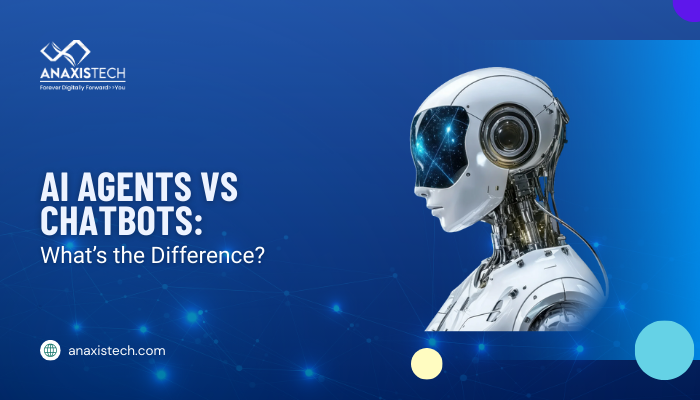
Artificial intelligence is rapidly transforming how businesses interact with users and automate operations. Two terms often used interchangeably—AI agents and chatbots—actually represent very different levels of intelligence and capability. While both are designed to interact with humans, their functionality, complexity, and business impact vary significantly.
Understanding the difference between AI agents and chatbots helps businesses choose the right solution for customer engagement, productivity, and automation.
What Is a Chatbot?
A chatbot is a software application designed to simulate human conversation, typically through predefined rules or AI-driven natural language processing. Chatbots answer questions, provide information, and perform simple tasks within a limited scope.
Key Characteristics of Chatbots
- Follows scripted or predefined conversation flows
- Responds to user input with limited contextual understanding
- Handles repetitive, predictable queries
- Operates within set rules or decision trees
Common Chatbot Use Cases
- Customer support FAQs
- Appointment scheduling
- Order tracking
- Basic lead qualification
Chatbots are effective for reducing support workload and providing instant responses, but they lack independent decision-making abilities.
What Is an AI Agent?
An AI agent is an autonomous system that perceives its environment, reasons over information, and takes actions to achieve specific goals. Unlike chatbots, AI agents can make decisions, learn over time, and perform complex tasks without human intervention.
Key Characteristics of AI Agents
- Goal-oriented and autonomous
- Can execute multi-step workflows
- Learns from data and past actions
- Integrates with tools, APIs, and systems
- Maintains long-term context
Common AI Agent Use Cases
- Automated business process management
- Intelligent assistants for software development
- Autonomous customer support escalation
- Sales pipeline optimization
- IT monitoring and incident resolution
Core Differences Between AI Agents and Chatbots
1. Level of Intelligence
Chatbots focus on conversation and responses, while AI agents focus on understanding, reasoning, and taking action.
2. Autonomy
Chatbots react to user queries. AI agents proactively perform tasks and make decisions to meet objectives.
3. Scope of Tasks
Chatbots handle single-step tasks. AI agents manage complex, multi-step processes.
4. Learning Capability
Traditional chatbots follow fixed rules or models, while AI agents continuously learn and improve from outcomes.
5. System Integration
AI agents are deeply integrated with enterprise tools and can trigger workflows across systems, unlike most chatbots.
Chatbots vs AI Agents: Quick Comparison
AspectChatbotsAI AgentsPrimary FunctionConversationDecision & actionAutonomyReactiveProactiveTask ComplexityLowHighLearning AbilityLimitedContinuousBusiness ImpactOperational efficiencyStrategic automation
Which One Should Businesses Choose?
Choose a Chatbot If:
- You need to handle FAQs or simple user interactions
- Your goal is quick deployment and low cost
- The tasks are predictable and repetitive
Choose an AI Agent If:
- You want intelligent automation across systems
- The workflow requires reasoning and decision-making
- You need scalable, autonomous execution
Many enterprises start with chatbots and evolve toward AI agents as their digital maturity grows.
Future Outlook
As AI advances, the gap between chatbots and AI agents will continue to widen. Chatbots will remain useful for front-line interactions, while AI agents will become central to business automation, orchestration, and intelligent decision-making.
Organizations adopting AI agents early will gain efficiency, innovation speed, and a long-term competitive advantage.
As businesses continue to evolve in a digital-first environment, the focus is shifting toward building systems that are not only responsive but also intelligent and adaptable. Organizations are increasingly looking for solutions that can handle complexity, reduce manual intervention, and improve overall efficiency across operations. This shift requires a deeper understanding of how different technologies fit into existing workflows and how they can be scaled effectively over time. By carefully evaluating needs, aligning tools with business objectives, and continuously optimizing performance, companies can create a strong foundation for long-term success. This approach ensures that technology adoption is not just a short-term upgrade, but a strategic move that supports innovation, agility, and sustainable growth.
In addition to selecting the right technology, success also depends on how effectively teams adopt and use these solutions in their daily workflows. Clear processes, proper training, and continuous feedback play a crucial role in ensuring smooth implementation. When employees understand how to use advanced tools efficiently, it leads to better productivity, fewer errors, and improved outcomes across departments. Businesses that prioritize adaptability and continuous learning are better equipped to respond to changing market demands. Over time, this creates a more resilient organization that can scale efficiently while maintaining consistency, quality, and operational control.
Conclusion
While chatbots and AI agents both enhance digital interactions, they serve very different purposes. Chatbots provide quick answers and basic automation, whereas AI agents deliver intelligent, autonomous execution. Choosing the right technology depends on business goals, complexity, and scalability needs.
Understanding this distinction empowers businesses to invest in AI solutions that drive real impact—not just conversations.



Leave a Reply