




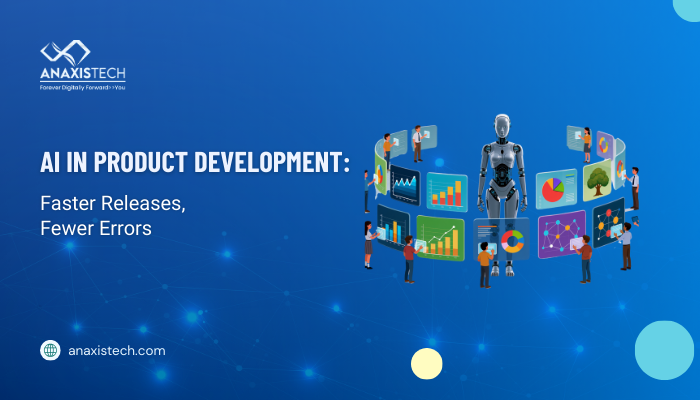
In today’s fast-moving digital landscape, product teams are under constant pressure to deliver high-quality products at speed. Missed deadlines, recurring bugs, and slow feedback cycles can derail innovation and impact customer trust. This is where ai in product development is transforming how modern products are designed, built, tested, and released.
By embedding artificial intelligence into the product lifecycle, organizations are achieving faster time-to-market while significantly reducing errors and rework.
Why AI Is Changing Product Development
Traditional product development relies heavily on manual processes, siloed teams, and reactive problem-solving. AI introduces intelligence, automation, and predictive capabilities that enable teams to move proactively rather than reactively.
With ai in product development, teams can analyze vast amounts of data, detect patterns early, and make informed decisions at every stage of the product lifecycle.
How AI Accelerates Product Releases
1. Smarter Requirement Analysis
AI analyzes user feedback, market trends, and competitor data to help teams define clear, data-driven product requirements. This reduces ambiguity and minimizes last-minute scope changes.
2. Faster Design and Prototyping
AI-powered tools assist in generating design variations, usability recommendations, and prototypes, enabling rapid experimentation and iteration.
3. Accelerated Development Cycles
Developers use AI to generate code, identify bugs, suggest optimizations, and automate repetitive tasks. This shortens development timelines and improves code quality.
4. Automated Testing
AI creates test cases, predicts high-risk areas, and executes tests continuously. This ensures faster validation without sacrificing reliability.
How AI Reduces Errors and Rework
Predictive Quality Assurance
AI identifies potential defects before they reach production, reducing costly post-release fixes.
Continuous Monitoring
AI monitors performance, user behavior, and system health in real time, flagging anomalies early.
Data-Driven Decision-Making
By replacing assumptions with insights, ai in product development minimizes errors caused by guesswork or incomplete information.
AI Across the Product Development Lifecycle
Ideation & Research
AI analyzes market gaps, customer needs, and feedback trends to guide product strategy.
Development
AI assists with coding, debugging, documentation, and dependency management.
Testing & QA
AI automates regression testing, performance testing, and security checks.
Release & Optimization
AI monitors post-launch performance and recommends improvements based on real user data.
Business Benefits of AI in Product Development
- Faster time-to-market
- Higher product quality
- Reduced development costs
- Improved team productivity
- Better alignment with customer needs
Organizations adopting ai in product development gain a competitive advantage by delivering reliable products at speed.
Challenges to Address
While the benefits are significant, teams must consider:
- Data quality and availability
- Integration with existing tools
- Skill gaps within teams
- Governance and ethical AI usage
Addressing these early ensures long-term success.
Best Practices for Adopting AI in Product Teams
- Start with high-impact use cases
- Keep humans in the decision loop
- Use AI to assist, not replace, teams
- Continuously measure performance improvements
- Invest in training and change management
A thoughtful approach ensures ai in product development delivers measurable value.
The Future of Product Development with AI
As AI models become more advanced, product development will shift toward continuous learning systems where products evolve based on real-time data. Teams will spend less time fixing issues and more time innovating.
The future belongs to organizations that combine human creativity with AI-driven intelligence.
Conclusion
AI is redefining how products are built and delivered. By enabling faster releases and reducing errors, ai in product development empowers teams to innovate confidently and efficiently. Companies that embrace AI today will set new standards for quality, speed, and customer satisfaction tomorrow.




Leave a Reply