




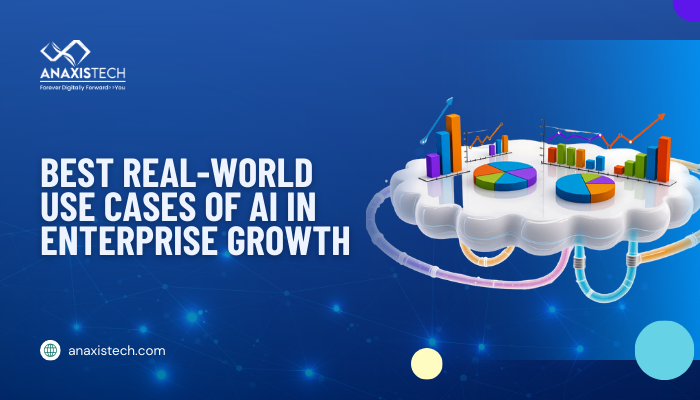
Artificial Intelligence is no longer an experimental technology reserved for innovation labs. Today, enterprises across industries are leveraging AI to drive measurable growth, improve efficiency, and gain competitive advantages. From optimizing operations to personalizing customer interactions, AI has become a strategic pillar for scalable enterprise success.
This blog explores the most impactful, real-world use cases where AI is accelerating enterprise growth.
Why Enterprises Are Investing in AI
AI enables businesses to analyze large volumes of data, automate complex processes, and uncover insights that are beyond human capabilities. As markets become more competitive, enterprises rely on AI not just to survive—but to scale intelligently.
Key benefits include faster decision-making, reduced costs, improved customer experiences, and enhanced innovation.
Top Real-World AI Use Cases Driving Enterprise Growth
1. Predictive Analytics for Strategic Decision-Making
Enterprises use AI-powered analytics to forecast sales trends, customer demand, and market shifts. Predictive models help leadership make proactive decisions, reduce risks, and allocate resources more effectively.
Business Impact:
- Better revenue forecasting
- Reduced operational uncertainty
- Smarter investment decisions
2. AI-Powered Customer Experience & Personalization
AI analyzes customer behavior, preferences, and interactions to deliver personalized recommendations, offers, and support across channels.
Real-World Examples:
- Personalized product recommendations
- Dynamic pricing strategies
- AI-driven customer service chatbots
Business Impact:
- Higher customer retention
- Improved engagement
- Increased lifetime value
3. Intelligent Process Automation (IPA)
AI-enhanced automation goes beyond basic workflows by handling decision-based and unstructured tasks, such as document processing and exception handling.
Business Impact:
- Faster business operations
- Lower manual workloads
- Improved accuracy and compliance
4. AI in Sales and Revenue Optimization
AI tools help sales teams identify high-quality leads, predict deal closures, and recommend next-best actions.
Use Cases:
- Lead scoring and prioritization
- Sales forecasting
- Automated CRM insights
Business Impact:
- Increased conversion rates
- Shorter sales cycles
- Higher revenue efficiency
5. Supply Chain and Logistics Optimization
AI enables real-time demand forecasting, inventory management, and route optimization for global supply chains.
Business Impact:
- Reduced inventory costs
- Improved delivery timelines
- Stronger supply chain resilience
6. Fraud Detection and Risk Management
Enterprises use AI models to detect anomalies, prevent fraud, and manage financial or operational risks in real time.
Industries Using This:
- Banking and finance
- Insurance
- E-commerce
Business Impact:
- Reduced financial losses
- Enhanced security
- Stronger regulatory compliance
7. AI-Driven Human Resource Management
AI supports hiring, employee engagement, and workforce planning by analyzing resumes, performance data, and sentiment trends.
Use Cases:
- Smart recruitment screening
- Employee attrition prediction
- Personalized learning pathways
Business Impact:
- Faster talent acquisition
- Improved employee retention
- Better workforce productivity
8. Product Development and Innovation
Enterprises use AI for market research, user feedback analysis, and product design optimization.
Business Impact:
- Faster innovation cycles
- Products aligned with market needs
- Lower R&D costs
How AI Use Cases Scale Enterprise Growth
- Enables data-driven decision-making
- Improves operational efficiency at scale
- Enhances customer satisfaction and loyalty
- Reduces overhead and operational risks
- Supports rapid expansion into new markets
Key Challenges Enterprises Must Address
Data Quality and Governance
AI success depends on clean, structured, and well-governed data.
Integration with Legacy Systems
Enterprises must modernize infrastructure to unlock AI’s full potential.
Ethics and Compliance
Responsible AI adoption ensures fairness, transparency, and trust.
Conclusion
AI is a proven growth engine for modern enterprises. The most successful organizations are those that move beyond experimentation and implement AI strategically across core business functions. By adopting real-world AI use cases that deliver measurable outcomes, enterprises can improve efficiency, innovation, and long-term competitiveness.
AI is no longer the future—it is the foundation of enterprise growth today.



Leave a Reply