




Introduction
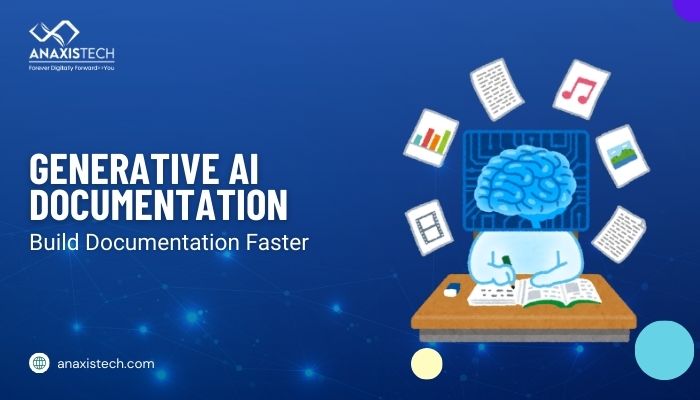
High-quality documentation is essential for modern businesses—whether it’s technical manuals, API documentation, user guides, or internal knowledge bases. However, creating and maintaining documentation is often time-consuming and resource-intensive. This is where generative AI documentation is changing the game.
Generative AI enables organizations to create accurate, consistent, and scalable documentation faster than ever before, allowing teams to focus on innovation instead of repetitive writing tasks.
What Is Generative AI Documentation?
Generative AI documentation refers to the use of artificial intelligence models that can automatically generate written content based on structured data, code repositories, or existing documents. These AI systems use natural language processing (NLP) and machine learning to understand context and produce human-like documentation.
From auto-generating release notes to creating step-by-step user manuals, generative AI significantly reduces the effort involved in documentation workflows.
Key Ways Generative AI Speeds Up Documentation
1. Automated Content Creation
Generative AI can instantly produce drafts for:
- Technical documentation
- User guides and FAQs
- API references
- Product manuals
This reduces manual writing time and ensures faster turnaround without compromising quality.
2. Consistency Across Documents
Maintaining consistency in tone, terminology, and formatting is a common challenge. Generative AI documentation tools ensure standardized language and structure across all documents, improving clarity and professionalism.
3. Faster Updates and Maintenance
When products or features change, documentation must be updated quickly. Generative AI can analyze code changes, version updates, or product modifications and automatically revise relevant sections, saving hours of manual effort.
Enhancing Developer and User Experience
Clear documentation improves both developer productivity and customer satisfaction. Generative AI helps by:
- Converting complex technical details into easy-to-understand language
- Creating multiple documentation formats for different audiences
- Supporting multilingual documentation for global users
This makes documentation more accessible and user-friendly.
Use Cases of Generative AI Documentation
1. Software Development Teams
AI can generate API documentation directly from code comments and repositories, reducing dependency on manual inputs.
2. Product and SaaS Companies
Generative AI helps build onboarding guides, feature explanations, and troubleshooting content that evolves with the product.
3. Enterprises and Internal Teams
Internal documentation such as SOPs, training manuals, and compliance documents can be created and updated efficiently using AI-powered tools.
Challenges and Best Practices
While generative AI documentation offers speed and scalability, it should be implemented thoughtfully. Best practices include:
- Human review for accuracy and compliance
- Clear prompts and structured inputs
- Secure handling of proprietary data
- Continuous AI model training
Combining AI efficiency with human expertise ensures reliable and high-quality documentation.
Why AnaxisTech for Generative AI Documentation?
At AnaxisTech, we help businesses implement intelligent generative AI documentation solutions that integrate seamlessly with development and content workflows. Our approach focuses on:
- Faster documentation cycles
- Improved accuracy and consistency
- Scalable AI-driven processes
- Secure and customized implementations
We empower teams to build documentation smarter and faster.
AI-powered documentation systems are helping organizations simplify complex content creation processes. By reducing the need for repetitive manual writing, teams can focus more on strategic tasks and product improvements. These systems can quickly generate structured content based on inputs such as code, data, or existing documents, making the overall workflow faster and more efficient. As a result, businesses can maintain high-quality documentation without increasing their operational effort.
Another key benefit is the ability to maintain clarity and readability across all types of content. Well-structured documentation improves user understanding and reduces confusion, especially when dealing with technical information. AI tools assist in breaking down complex topics into simpler explanations, making the content accessible to a wider audience. This improves both user experience and internal efficiency, as fewer resources are needed to explain or support the documentation.
Documentation processes also become more agile with the support of intelligent systems. Updates can be made quickly whenever there are changes in products or services, ensuring that information remains accurate and relevant. This reduces the risk of outdated content and helps maintain trust with users. Faster updates also allow teams to respond quickly to market changes and evolving customer needs.
Collaboration between teams is another area that benefits significantly. With automated assistance, different departments such as development, marketing, and support can contribute more effectively to documentation. Shared workflows and consistent formats make it easier to align content across teams. This leads to better communication and a more unified approach to knowledge sharing within the organization.
Scalability is also improved as businesses grow and expand their offerings. Managing large volumes of documentation manually can become challenging over time. Intelligent automation allows organizations to handle increasing content demands without compromising on quality. This ensures that documentation remains consistent, up-to-date, and aligned with business goals, even as operations scale.
Conclusion
Generative AI is transforming how organizations create and manage documentation. By adopting generative AI documentation, businesses can significantly reduce time, improve consistency, and enhance user experience—while keeping documentation aligned with rapid product changes.
With AnaxisTech’s AI expertise, documentation becomes a strategic asset rather than a bottleneck.





Leave a Reply